In partnership with

HI AND WELCOME TO
AI & ChatGPT Central
Today’s edition breaks down the eight prompting styles that dramatically improve how ChatGPT thinks, reasons and analyzes.
This guide shows you when to use ReAct for investigations, Chain-of-Thought for complex reasoning, Tree-of-Thought for decision analysis and Self-Ask for deep research.
You’ll also learn how to shape outputs with Role-Play, Few-Shot patterns, Self-Critique loops and Socratic prompting.
Love you,
👩🏻 Kris & The ChatGPT Central Team

8 Prompting Styles Every Pro Should Master ⤵️
Download this guide which can help you use eight advanced prompting styles to improve reasoning, accuracy, analysis and output quality.
Inside the Guide You’ll Learn How To
Use ReAct to combine reasoning + tool use for real-world lookup tasks
Apply Chain-of-Thought to force transparent step-by-step reasoning
Run Tree-of-Thought to compare options and pick the best path
Use Self-Ask With Search for deeper research via sub-questions
Shape tone precisely with Role-Play setups
Copy patterns using Few-Shot prompting
Improve clarity using Self-Critique loops
Challenge ideas with Socratic prompting for stronger reasoning
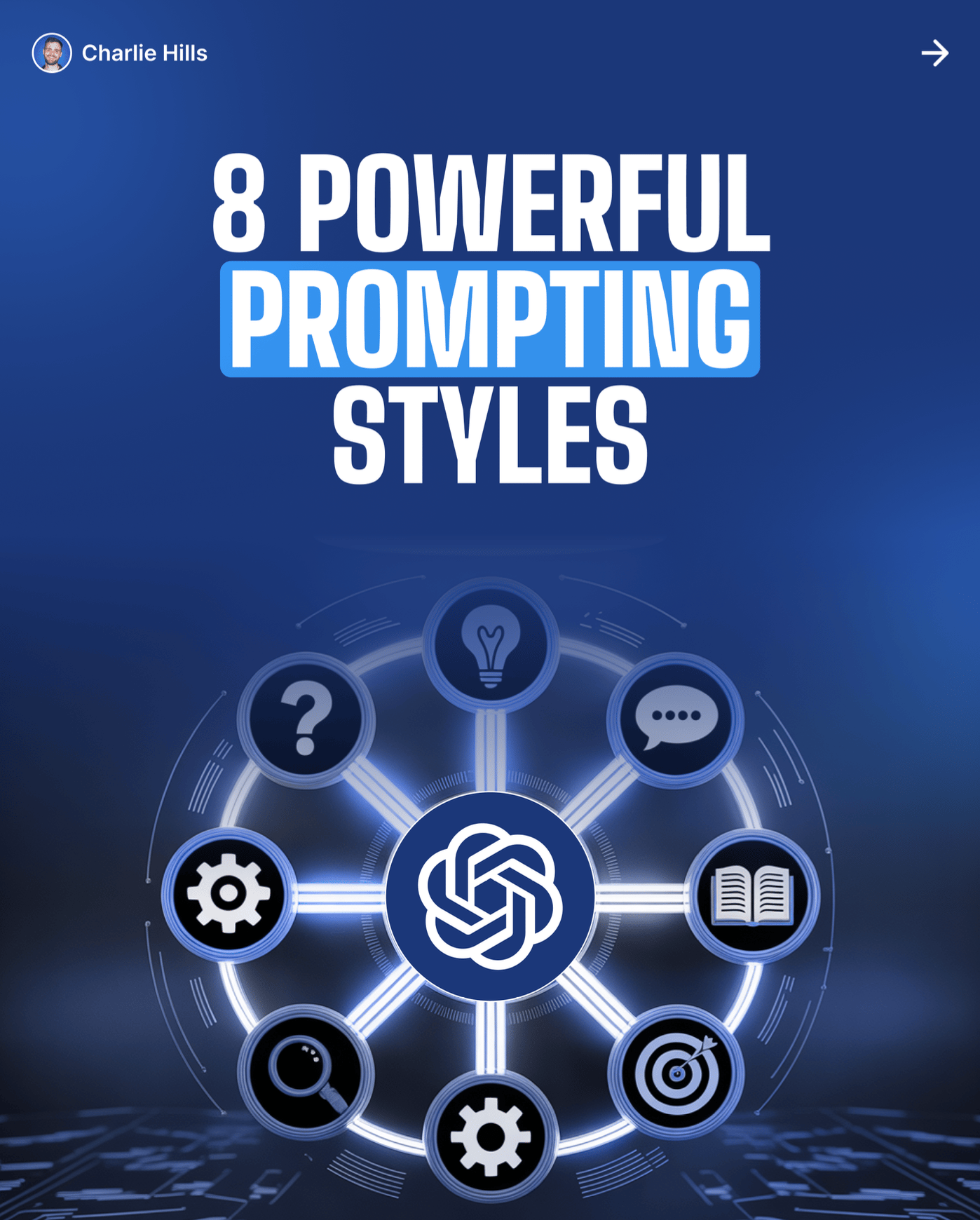
This guide distills eight powerful prompting styles that elevate ChatGPT from a basic assistant into a structured reasoning engine. On page 2, the ReAct framework teaches you how to combine thought processes with tool usage, making the model decide what action to take before generating the answer.
Page 3 demonstrates Chain-of-Thought with step-by-step logic to surface hidden mistakes early.
Tree-of-Thought on page 4 shows how to compare multiple strategies, list pros and cons, and select the strongest option.
Page 5’s Self-Ask method breaks complex problems into sub-questions and answers them one by one with sources.
Role-Play on page 6 helps you set personality, tone, and expertise, while page 7’s Few-Shot setup trains the model by showing patterns.
Finally, pages 8 and 9 walk through Self-Critique and Socratic prompting, two frameworks that dramatically improve clarity, reasoning and final output quality.
Execution Steps
Start with one framework: ReAct, Chain-of-Thought, or Tree-of-Thought.
Copy the template and apply it to one task you run daily.
Add Fact-Check or Self-Critique steps when accuracy matters.
Use Role-Play whenever you need tone, expertise or persona control.
Use Few-Shot examples to teach the model your style or format.
Combine two frameworks for complex tasks (e.g., CoT + Socratic).
Save your best outputs and convert them into reusable prompt templates.


Black Friday DEAL (ONLY 80 LEFT)
✅ $3.99 trial for 1 month (then $39.75/year)
✅ Instant access
✅ All future updates included
✅ 30-day money-back guarantee
⏰ ONLY FOR THE FIRST 80 PEOPLE
If you have been curious about AI but overwhelmed by where to start, this is the lowest-risk entry point we have ever offered.
The 📚 Ultimate AI Library is a web based platform that gives you instant access to a curated collection of 1200+ practical AI and ChatGPT tutorials, workflows, templates, and prompts, all organized by topic, use case, and author so you can find exactly what you need in minutes. Instead of scrolling endless feeds or piecing together scattered tips, you get step by step, non technical implementations you can apply right away, plus weekly updates with new content and a community of professionals using the same proven playbooks to save time, automate work, and build a real edge with AI.
Inside you will find:
1200+ practical AI implementations (real workflows, real use cases)
500+ ready-to-use templates (prompts, frameworks, examples)
Clear, non-technical explanations (built for busy professionals)
Search + filters by topic, author, and use case (find what you need in minutes)
Organized categories (no endless scrolling)
Weekly updates (fresh tactics added regularly)
Community access with 2000+ professionals
And yes, it is better than bookmarking posts:
LinkedIn content disappears, gets buried, and is hard to find again
The Library is permanent, searchable, and structured
🎤 Share Your Ideas

Drop us a message and let us know the topics you’d like us to explore in future editions. What’s on your mind?
